
Jobs-to-Be-Done Interview Techniques
Understand the emotional and social forces that actually drive customers to switch products.
Jobs-to-Be-Done interviews don't ask people what they want. They ask people what they did, in what order, and why, on the theory that customers hire products to make progress in their lives and that progress leaves a reconstructable trail. That distinction, causality over preference, is what separates a JTBD interview from a standard usability or satisfaction interview, and it's why the two produce almost entirely different data from almost the same conversation.
Two schools have formalized this approach, and naming both matters because they solve different problems. The Christensen and Moesta school builds narrative reconstructions of a single switching moment, chasing the demand-side forces that pushed someone off their old solution and pulled them toward a new one. A competing school takes the opposite approach: it breaks a job into discrete, measurable steps and outcome statements, then surveys those statements at scale to rank which ones matter most. Neither replaces the other. The two approaches are designed to work in sequence rather than in competition. This piece is about the first school, the interview technique that reconstructs the switch itself.
The three dimensions of a job teams consistently miss
Every job a customer hires a product to do has three layers stacked on top of each other. There's the functional dimension, the actual task getting done. There's the emotional dimension, how the person wants to feel once it's done. And there's the social dimension, how they want to be seen by the people around them while doing it.
Most product teams stop at the first layer. They'll identify something like "manage project timelines" and treat that as the job, full stop. The emotional job underneath that (wanting to feel in control, not blindsided by a missed deadline) and the social job on top of it (wanting to look competent in front of leadership) produce the actual purchase decision; the functional job alone does not explain it. A tool that nails the functional task but leaves someone feeling anxious or looking sloppy in a status meeting will lose to a worse tool that handles all three.
This isn't just a positioning problem, it's a research design problem. Asking only functional questions in an interview gets only functional answers back, because participants answer the question in front of them. Surfacing the emotional and social dimensions requires deliberately different question types and different timing in the conversation, which is a large part of what the rest of this piece covers.
The Four Forces model and what it reveals about why customers switch
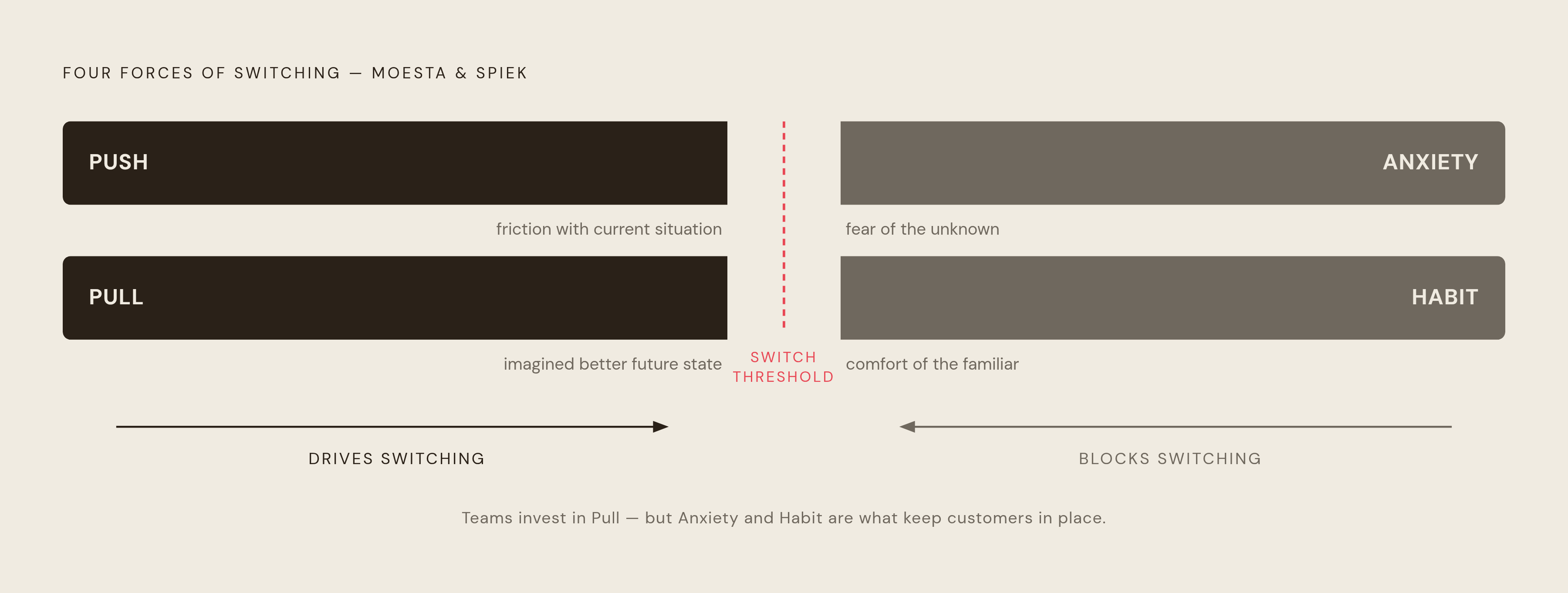
Bob Moesta and Chris Spiek's Four Forces model gives structure to the switching decision itself. Four forces are always in play, and a switch only happens when two of them beat the other two.
Push is the friction with the current situation: a problem becomes urgent once it is no longer tolerable. Pull is the vision of a better life the customer projects onto the new solution, not a feature list but an imagined future state. Anxiety is the fear of the unknown attached to the new option, and it's the most underestimated of the four because no amount of additional features resolves it. Habit is inertia: the comfort of the current way means sticking with what's familiar requires no decision.
A customer switches only when Push plus Pull outweighs Anxiety plus Habit. When Anxiety plus Habit outweighs Push plus Pull, the customer stays, regardless of how good the new product actually is. Most product and marketing teams pour their effort into the Pull side of the ledger: better features, sharper messaging, a more compelling demo. That effort is often wasted, because Anxiety and Habit are usually what's actually holding the customer in place, and neither responds to a better pitch. The interview exists to fill in all four quadrants with specific, concrete evidence, not vague impressions of what a segment "generally" feels.
Why recent switchers are the only reliable source to recruit
Recruitment for a JTBD interview is behavioral. The right screening criterion looks like "people who stopped using Product A and adopted Product B in the last 60 days," not "Millennial marketing managers." A demographic label tells a team nothing about causality; a recent switch is the causal event itself, still fresh enough to reconstruct.
Memory is the real constraint here, and it's an unforgiving one. Past roughly 90 days, the specific detail a switch interview depends on (the triggering moment, the exact conversation, the specific complaint) starts to erode. Customers who bought within the last six months are workable even for a less experienced interviewer. Anyone who bought between six months and a year and a half ago is a harder interview, and novice interviewers in particular will struggle to pull a clean timeline out of that group. The practical move is to start recruiting within that six-month window and only expand it once the interviewer's recall-prompting technique (timeline-anchoring, covered below) is solid enough to handle the gaps.
Long-time loyal customers should be excluded entirely from this kind of study. Their switching moment happened too long ago to reconstruct with fidelity, and their current satisfaction bleeds backward into the retelling, smoothing over the exact friction and doubt that made the decision hard.
The number of interviews needed to see patterns
No fixed number holds across every source on this, but the range that shows up consistently in current guidance is around 8 to 15 interviews for a given job. Patterns start to show at 5 to 8 interviews, but showing up isn't the same as holding up. Treating five interviews as sufficient evidence is drawing a conclusion from noise, not signal.
Confidence in a pattern generally requires something closer to 10 to 15 interviews. That said, volume is not the only variable that matters, and it may not even be the main one. A single participant who made the switching decision themselves, recently, and can walk through it in granular detail is worth more to the analysis than two participants who barely remember the sequence of events or who weren't the actual decision-maker. Depth of recall and depth of involvement in the decision outweigh raw interview count.
Setting up the interview so participants tell stories instead of giving opinions
Block off 60 to 90 minutes. Anything shorter doesn't leave room for the participant to relax into the conversation, and the first stretch of a good switch interview is often just that: easing someone into a state where they'll tell the messy version of events instead of the clean one.
A useful framing device up front is the documentary-maker pitch: something like, "Imagine this is for a documentary. I'm just trying to understand exactly what happened, there are no wrong answers, and boring details actually help." That framing does real work. It takes the pressure off the participant to sound smart, coherent, or flattering, and it gives explicit permission to say "I don't remember" or to wander into a detail that seems irrelevant.
The opening question in nearly every switch interview is some version of: "Why did you buy [product], and where were you when you bought it?" Starting from the purchase and working backward is easier on memory than starting from the problem and working forward, because the purchase is a concrete, dated event the participant can actually locate.
Timeline-anchoring: the technique that separates recalled events from constructed narratives
A switch interview is reconstructing a sequence of distinct moments across the customer's timeline, not one vague period of dissatisfaction.
Timeline-anchoring means every claim in the interview gets tied to a specific moment instead of floating as a general state. "I was unhappy with the old tool" isn't usable data. "The moment I realized the old tool wasn't working was when the export failed during the board meeting" is. That specificity is the entire point of the technique.
Getting there sometimes calls for what's known, somewhat informally, as asking for the name of the dog: pushing for small, concrete, seemingly irrelevant detail to strengthen recall. If someone mentions signing up at the kitchen table, ask if it was morning or night. If they mention a trip, ask whether the purchase happened before or after it. If a dog was barking in the background, ask what the dog's name was. None of that detail matters on its own, but chasing it forces the participant out of a summarized, edited version of events and back into the actual memory, dragging adjacent details along with it. Weather, light, temperature, all of it works the same way: trivial on the surface, but effective at locating a person in time.
Probing for forces: how to surface push, pull, anxiety, and habit in a single conversation
Each of the four forces needs its own line of questioning, and conflating them is the fastest way to end up with a flat, undifferentiated interview transcript.
Push questions go after the struggling moment: "When did you first realize the old solution wasn't working?" "What triggered you to start looking for something different?" "What were you putting up with that you shouldn't have had to?" Pull questions chase the imagined future: "What did you picture using this would be like?" "What were you hoping would be different once you made the switch?" Anxiety questions dig for the hesitation that almost stopped the whole thing: "Did you have any concerns before you committed?" "Was there anything that almost talked you out of it?" "What did you worry might go wrong?" And Habit questions reveal the inertia of the old way, produced by asking: "What else did you consider?" "If this hadn't existed, what would you have done instead?" "What made it hard to leave the old way behind?"
After nearly any answer, the follow-up is the same: "And why did you need to do that?" or "Why was that important to you?" Pressing at least twice past the first answer is what turns a surface-level response into something closer to the actual reason. The single most common failure in these interviews is accepting a generalization at face value instead of pushing it down to a specific incident, a specific day, a specific conversation. A generalization is a summary the participant has already told themselves; the interview's job is to press past it to the specific incident underneath.
The analysis step that turns interview notes into a usable forces map and job statement
A completed set of switch interviews should produce three things. The first is a Forces Map: a rollup of push, pull, anxiety, and habit evidence across every interview, with frequency counts and representative quotes attached, showing which forces recur and which are outliers. The second is a Job Statement, a single sentence that names the functional, emotional, and social job the product gets hired to do, written in the customer's own language rather than the product team's internal vocabulary, and deliberately agnostic about any particular solution. The third is a set of Opportunity Gaps: the specific points in the switch journey where customers hit friction, which mark where the product is currently falling short of completing the hire.
One of the more useful findings to come out of this method repeatedly is that customers in wildly different demographic buckets often share the same underlying job, while customers who look identical on paper (same age, same company size, same industry) often turn out to be hiring the product for completely different jobs. Segmenting by job tends to produce a more actionable product strategy than segmenting by age or firmographic data, because job-based segments actually predict behavior.
Spotting where to invest next comes down to overlaying two variables: how important a given outcome is to the customer, and how dissatisfied they currently are with the options available to meet it. Where both run high, that's the territory most likely to produce real switching behavior. For teams planning to run the Ulwick, ODI phase next, this qualitative work is the necessary first step: a single market usually contains a long list of measurable desired outcomes, and the job map built from switch interviews is what gives the later quantitative survey its structure. The narrative interview finds the shape of the job. The outcome survey finds out which parts of that shape matter most.
Sources
- Job to be done interviews: How to conduct them in 2025
- Putting the Jobs to be Done Interview to Practice
- How to Conduct a Jobs-to-be-Done Interview That Uncovers Unspoken Customer Desires
- Jobs to be Done, Taught by Bob Moesta & Chris Spiek
- jobstobedone.org
- jobstobedone.org
- jobstobedone.org
- jobstobedone.org